
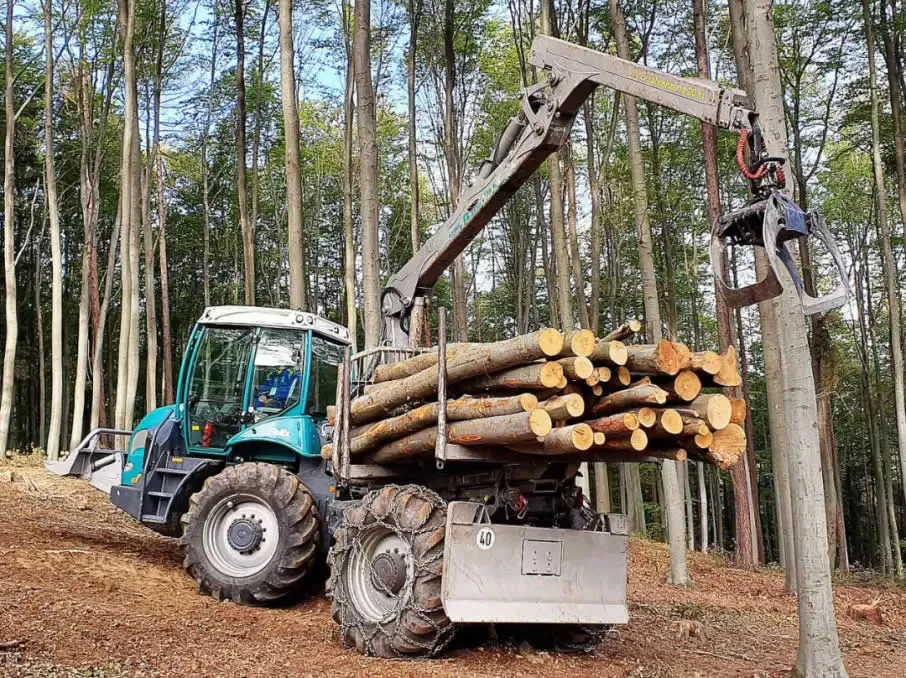
In mechanized logging and timber harvesting operations, timber harvesters are crucial machinery connecting forest resources with downstream processing. As a maintenance engineer, I handle various machine models daily, and their main drive system and cutter head structure are core components ensuring efficient and stable operation. The driveshaft is responsible for power transmission, while the cutter head directly undertakes the tasks of cutting/chipping/shredding timber. After prolonged operation in the complex forest environment, these components are prone to wear, loosening, or failure; therefore, routine maintenance is essential.
The driveshaft is the power bridge connecting the engine/hydraulic motor and the cutter head (or shearing head/chipping disc). It withstands torque, bending, and vibration loads during operation.
1.1 Preparation Before Maintenance
Shutdown and Cooling
After operation, immediately stop the machine and wait for the driveshaft and cutter head temperature to drop to within 20°C of ambient temperature (usually 15–30 minutes) to prevent hot grease splashing or metal thermal stress deformation.
Power Disconnection
Disconnect the tractor's power take-off shaft (PTO) connection, lock the main clutch, and display a "Under Maintenance" warning sign to prevent accidental starting.
Operating Environment
In rainy and humid areas, maintenance must be performed in an indoor drying shed or rainproof shelter. Operation in the open air or on slippery surfaces is strictly prohibited to prevent moisture from entering the bearings and flange interfaces.
1.2 Cleaning and Inspection
After daily operations, first clean up dirt, bark, sand, and other accumulated debris around the drive shaft. Accumulated dirt and sand not only accelerate the wear of seals and bearings but can also cause unbalanced vibration.
After cleaning, inspect the drive shaft:
Check for cracks, bends, or abnormal wear on the surface;
Check for looseness in universal joints, couplings, and other connections;
Pay attention to whether bushings, keyways, and bolts show signs of loosening or deformation.
This inspection process can detect potential faults early, avoiding the risk of serious damage or breakage.
1.3 Lubrication and Rotation Performance Confirmation
Key components on the drive shaft, such as universal joints and needle roller bearings, require grease lubrication as specified. Lubrication reduces friction, slows wear, and minimizes heat buildup. Using high-pressure grease is the industry recommendation (the grease for logging machinery needs to withstand high loads).
Maintenance Steps:
Add grease to the lubrication points recommended by the manufacturer;
Use manual or electric lubrication equipment to ensure the grease is fully absorbed;
After lubrication, manually rotate the drive shaft to confirm there is no jamming or abnormal resistance;
Relubricate after each cleaning, especially after working in wet or muddy environments.
1.4 Tightening and Coaxiality Adjustment
The balance and coaxiality of the drive shaft are crucial for smooth operation. During routine maintenance, confirm:
The tightness of all coupling bolts;
Whether the drive shaft is coaxial with the drive-side/cutter head-side shaft hole;
Whether abnormal vibration originates from drive shaft misalignment.
Incorrect coaxiality will accelerate damage to bearings, seals, and gears, thus shortening the overall machine lifespan.
1.5 Special Maintenance of the Driveshaft
|
Maintenance Project |
Operating Procedures |
Frequency |
Key points |
|
Universal joint cleaning |
Use a wooden scraper to remove accumulated sawdust and bark fibers from inside the bushing; do not use metal tools to scrape. |
After daily homework |
Fiber entanglement can lead to grease failure and accelerate needle roller wear. |
|
Spline shaft lubrication |
Injecthigh-temperature anti-wear lithium-based grease (NLGI Grade 2)through the grease fitting until old grease overflows, then wipe away any excess. |
Every 50 hours |
The grease must containextreme pressure additives (EP); ordinary calcium-based grease is prohibited. |
|
Connecting flange fastening |
Use a torque wrench to tighten the PTO connecting bolts; the standard torque is120 N· m. |
Every 100 hours |
Loose bolts are the primary cause of drive shaft breakage. |
|
Initial dynamic balancing inspection |
Manually rotate the drive shaft and observe whether there is periodic shaking or abnormal noise. |
Every 200 hours |
If significant vibration occurs, the device needs to be sent to a professional organization for dynamic balancing. |
The cutter head is the core component of the wood harvester, responsible for its core operations. The sharpness of the blades, the tightness of their installation, and the overall balance of the cutter head directly affect work efficiency and product quality.
2.1 Cleaning Accumulated Debris and Inspecting the Blades
After each operation, immediately use tools to remove wood chips, bark fragments, and other residues around the cutter head. Long-term accumulation will hinder normal blade cutting and may even cause the cutter head to become unbalanced, resulting in vibration.
Inspection items include:
Whether the blades have obvious nicks, cracks, or deformation;
Whether the blade fixing bolts are loose;
Whether the cutter head is unbalanced due to uneven wear.
Severely worn or damaged blades should be replaced promptly. It is generally recommended to keep the blades sharp to ensure cutting efficiency and reduce cutter head vibration. Furthermore, different machine models have different cutter head structures and fixing methods; the specific inspection sequence should be referred to the equipment manual.
2.2 Sharpening and Replacement of Blades
Blades will become dull after long-term operation; this is normal wear. Dull cutting blades will cause:
Increased power consumption;
Deteriorated cutting quality;
Increased load on sub-components.
The sharpness of the cutting blades should be checked regularly, and sharpened as necessary. When hard blades are worn, they can be re-sharpened using professional sharpening tools, or the entire blade set can be replaced if the wear exceeds the allowable range. Blade uniformity is also important; uneven blades will cause blade head vibration and uneven load on the drive shaft.
|
Judgment Indicators |
Normal state |
Abnormal state |
Disposal measures |
|
Blade sharpness |
The cutting edge is a continuous sharp edge, without any chipping. |
Edge dulling, chipping ≥0.5mm |
Stop the machine immediately and send it for repair, polishing, or replacement. |
|
Blade gap |
Maintain a thickness of 0.5–1.0 mm. |
>1.5mm or partial bonding |
Adjust the shim thickness and recalibrate the gap. |
|
Blade material |
cemented carbide (HRC≥60) |
Obvious oxidation and discoloration |
Replacing the blade witha tungsten carbide-based composite bladeimproves corrosion resistance by 40%. |
|
Cutter head surface |
Smooth and free of carbon buildup |
Adhesive resin and gum clumps |
Remove by soaking and softening witha special wood resin solvent (non-acetone). |
2.3 Blade Head Balancing and Installation Inspection
Blade head balancing is crucial for reducing vibration and extending bearing life. When reinstalling the blade head, be sure to:
Use professional equipment to check the dynamic and static balance;
Tighten all fixing bolts diagonally and symmetrically;
Ensure the blade head mounting surface is clean and free of impurities.
For large timber harvesters, blade head balancing is particularly critical, as severe vibration can cause cascading damage to the main drive shaft, gearbox, and even the entire chassis.
2.4 Cutter Head Disassembly and Assembly Specifications
Before disassembly, mark the original installation angle of each cutter blade (using a marker pen for numbering);
During installation, tighten the bolts in a diagonal, alternating sequence, increasing the torque in three stages to the standard 85 N·m;
After installation, manually rotate the cutter head 3 times to confirm there is no jamming or abnormal noise.
2.5 Dynamic Balancing Verification Procedure
Frequency: Must be performed after every 2 sets of cutters are replaced or after 800 hours of cumulative operation;
Method:
Install the cutter head on a dedicated dynamic balancing machine;
Start at the rated speed (usually 1200–1800 rpm);
Record the vibration amplitude and phase angle;
Add counterweights to the unbalanced area (welded counterweights are recommended; adhesive counterweights are prohibited);
Repeat the verification until the vibration velocity is ≤2.8 mm/s (ISO 1940-1 G6.3 standard).
Note: Poor dynamic balance will shorten the spindle bearing life by more than 60% and is the root cause of cutter head noise and frame cracking.
From an engineer's perspective, maintenance is not a one-time task, but a cyclical process. Typical recommended maintenance schedules are as follows:
For high-intensity operating environments:
Clean the drive shaft and cutter head after daily operation, and perform basic checks and lubrication;
Conduct a thorough inspection of the transmission system's tightness at least once a week;
Perform a more complete overhaul monthly or every 50–100 hours of operating time (including drive shaft coaxiality check, cutter head dynamic balancing, etc.).
In damp, muddy, or sandy operating areas, maintenance cycles need to be shorter and more frequent.
|
Part |
Protective measures |
Frequency |
Recommended materials |
|
Exposed section of drive shaft |
Applya thin layer of rust inhibitor spray(such as WD-40 Specialist Long-Term Corrosion Inhibitor). |
After daily homework |
Avoid using regular engine oil, as it easily attracts dust and forms grinding paste. |
|
Flange connection face |
Applya composite aluminum-based rust-preventive grease(such as Shell Alvania R3). |
Weekly maintenance |
It exhibits superior water resistance compared to lithium-based grease and withstands salt spray corrosion for up to 500 hours. |
|
Cutter head inner cavity |
Injectvolatile rust inhibitor(such as VCI-100), seal and store. |
Long-term parking |
The oil film can evaporate to form a vapor phase protective layer, eliminating the need for disassembly. |
|
Bolts and fasteners |
Zinc-aluminum coating rustinhibitor |
After each disassembly and reassembly |
Prevent electrochemical corrosion, especially in sulfur-containing rainwater. |
Timber harvesters are often used in complex environments such as forests and mountains. Operational safety must be a top priority during maintenance. The following are basic safety requirements:
Ensure the equipment is completely stopped and all kinetic energy released before operation;
Maintenance personnel must wear protective equipment;
High-temperature components must be allowed to cool naturally before touching;
Use the correct specifications of lubricating materials and tools.
Maintenance is not only crucial for extending the lifespan of machinery, but also for ensuring operational safety and reducing failure rates.
As the "heart" components of a timber harvester, the drive shaft and cutter head require meticulous, frequent, and clearly defined maintenance and upkeep. Daily cleaning, regular lubrication, and inspection not only improve equipment reliability but also significantly reduce on-site downtime repair costs. Through meticulous inspection, proper lubrication, and timely maintenance, we can ensure the timber harvester operates stably and efficiently for extended periods in harsh environments.

