
During long-term operation of a grader, the hydraulic steering system and blade are key working mechanisms. Their health directly affects the machine's maneuverability, operating efficiency, and service life. As a front-line maintenance engineer, performing routine checks and maintenance on these two components after each operation is fundamental to preventing malfunctions, reducing maintenance costs, and extending service life.
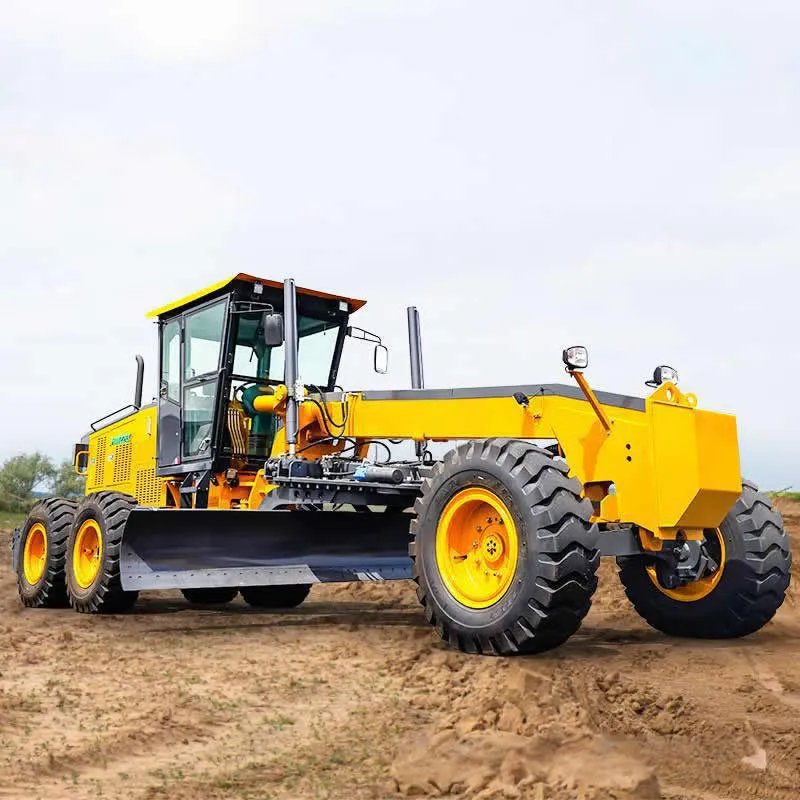
The hydraulic steering system is the core of the grader's steering system. It converts the driver's steering wheel input into hydraulic pressure, driving the steering cylinder to turn the wheels. Hydraulic steering typically relies on the coordinated operation of components such as a hydraulic pump, control valves, and steering cylinders. Its performance is significantly affected by factors such as hydraulic oil quality, sealing, and mechanical wear. If the steering system malfunctions or becomes sluggish, it not only affects the overall machine's handling but may also create safety hazards.
Therefore, the primary purpose of maintaining the hydraulic steering system is to keep the system clean, well-sealed, with normal hydraulic oil parameters, and with reliable actuator response. These seemingly simple steps are crucial for ensuring the stable operation of the entire machine.
After each operation, the hydraulic steering system of the grader should be inspected and maintained in detail as follows:
2.1 Oil Condition Check
After operation, immediately check the hydraulic oil level in the tank to ensure it is in the middle range of the upper and lower marks. If the level continues to drop, check for leaks in the pipe joints, steering valve body, and cylinder seals. Adding different brands or batches of hydraulic oil is strictly prohibited to avoid emulsification or additive inactivation due to oil mixing.
2.2 Filter and Oil Cup Cleaning
After daily operation, disassemble the hydraulic oil cup and wipe the inner wall with a clean cotton cloth to remove sediment and impurities. Replace the suction filter every 200 hours of operation, and replace the main hydraulic oil every 500 hours or when the oil turns black or cloudy. In the Chongqing area, it is recommended to shorten the replacement period to every 400 hours to address the issue of accelerated oxidation at high temperatures.
2.3 Leakage and Seal Inspection
Focus on inspecting the connection surface between the steering gear housing and valve body, high-pressure hose joints, and piston rod seals. Use the white cloth wiping method: lightly wipe suspected leak points and observe for oil stains. Rubber seals have a 40% shorter lifespan in environments above 35℃; any hardening, cracking, or deformation must be replaced immediately.
2.4 System Bleeding and Operating Procedures
If the steering operation exhibits "floating," "sluggishness," or abnormal noise, the following bleeding procedure must be performed:
Start the engine and allow it to idle;
Turn the steering wheel fully to the left and right 3 times each, each time for no more than 3 seconds;
After stopping the machine, check if the oil level has dropped and replenish it to the standard value.
It is strictly forbidden to turn the steering wheel to its full lock while stationary to prevent hydraulic pump overload and frequent opening and closing of the relief valve, which could lead to excessive system temperature rise (>80℃).
2.5 Hose and Pipeline Protection
Check all hydraulic hoses for friction with the frame, radiator, and tracks. Replace the hose every 1000 hours or when the surface of the hose hardens or bulges to prevent the inner layer from peeling and clogging the valve core. Chongqing is rainy and humid; it is recommended to use oil-resistant and weather-resistant rubber hoses (such as NBR+EPDM composite material).
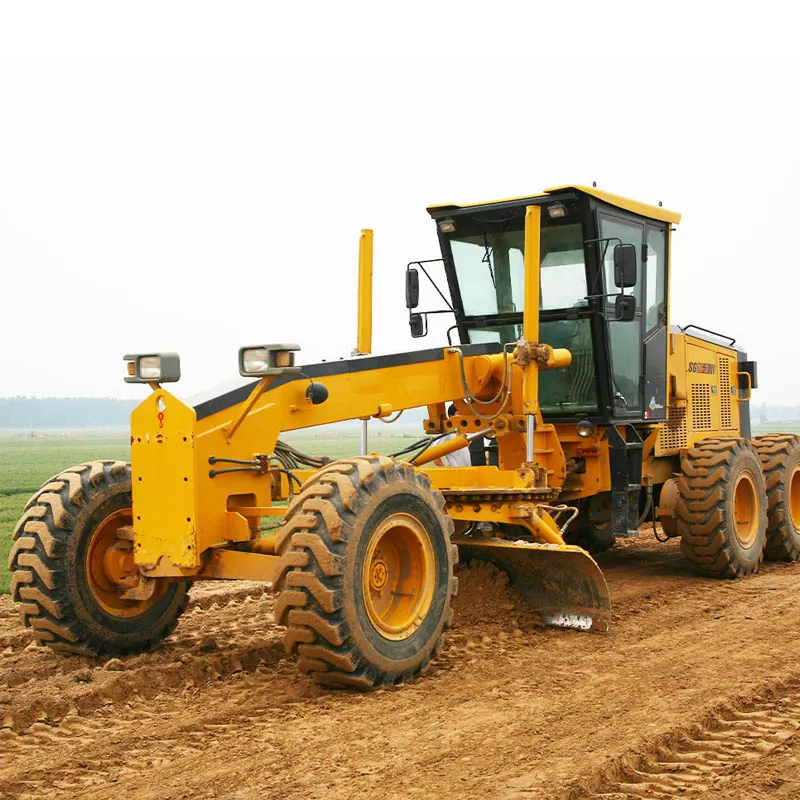
The blade is the part of the grader that directly contacts the ground. Its wear condition affects the construction quality, such as flatness, profile consistency, and material stacking effect. Most modern grader blades are made of highly wear-resistant materials and can be designed as flip-over or replaceable parts, thereby extending the overall lifespan and reducing long-term costs.
Blade maintenance can be approached from the following aspects:
Clean the contact surface between the blade and the blade plate, as well as the guide rails. After operation, the blade surface often adheres to dirt, gravel, and other debris. These particles can cause jamming or irregular wear in the blade extension mechanism. Therefore, rinsing with a water gun or cleaning the residue with the blade blade is a necessary task after each shutdown.
Check the wear condition of the blade. The cutting edge and blade (cutting tip) of the shovel wear rapidly and are the most common consumable parts. Depending on the material properties and workload, inspections can be performed daily, per shift, or every 25-50 hours. If significant dulling, cracks, or obvious dents are found at the edges, the blade should be sharpened or replaced promptly to ensure the quality of the ground shaping and reduce the additional load on the hydraulic lifting mechanism.
During inspection, check for loose fasteners and the flexibility of the position adjustment mechanism. The shovel blade is connected to the main unit via connecting rods and slide rails. Wear or loosening of these connection points can lead to inaccurate shovel blade movement, affecting operational accuracy and symmetry. Furthermore, if difficulty in adjusting the lateral angle of the shovel blade is found, check for any abnormalities in the hydraulic cylinder and control valves.
For shovel blade designs with flip-over blades, the blade should be flipped periodically to use the other side, evenly distributing wear and extending the overall blade life. More maintenance methods can be found in the table below:
|
Maintenance Project |
Operating Standards |
Inspection methods |
Change threshold |
|
Edge wear |
A blade thickness of ≥5mm is considered a safe threshold. |
Use vernier calipers to measure the thinnest part of the cutting edge. |
Thickness ≤3mm or ≥2 gaps >10mm |
|
Cutting angle adjustment |
Operating range 30°–65° |
Adjusted via hydraulic control handle, calibrated using an angle gauge. |
Angle deviation > ±3° affects flatness accuracy |
|
Horizontal rotation angle |
±40°–60° (bidirectional) |
Manually rotate the scraper to its limit and check for any jamming. |
Slewing bearings with clearance >1.5mm need to be replaced. |
|
Vertical rotation angle |
±25° |
Check the synchronization of the lifting cylinder |
A height difference of more than 10mm/2m between the two sides requires calibration. |
|
Slide rails and connectors |
No unusual noises, no looseness |
Hand-cranked scraper to detect axial movement |
Bolts need to be tightened if the torque is 20% lower than the standard value. |
Post-operation cleaning requirements
Use a high-pressure water gun (≤10MPa) to remove clay, stone chips, and grass roots from the blades, slide rails, and rotating ring. Do not use a wire brush to scrape the blade edge, as this will prevent the hardened surface layer from peeling off. Immediately after cleaning, evenly spray the blade edge and all metal joints with a rust inhibitor (such as WD-40 Specialist).
|
Maintenance System |
Risk characteristics |
Response measures |
|
Hydraulic system |
Oil temperature easily exceeds 85℃, viscosity decreases by 30%, and oxidation rate accelerates. |
Installa hydraulic oil temperature monitoring and alarm device; usesynthetic anti-wear hydraulic oil (ISO VG 46, anti-oxidation type); change the oil every 400 hours. |
|
Metal parts |
The blade, hinge pin, and bolts corrode rapidly, making disassembly difficult. |
All exposed steel components are coated withan epoxy zinc-rich primer followed by a polyurethane topcoat; fasteners are made ofstainless steel or galvanized alloy. |
|
Electrical system |
Moisture causes a decrease in the insulation of the wiring harness, making the solenoid valve coil prone to burnout. |
Check connectors for oxidation monthly; usewaterproof connectors (IP67); placedesiccant packets inside the control cabinet. |
|
Complete machine parking |
Long-term parking can easily lead to internal leakage in the hydraulic cylinder and tire deformation. |
When parking,raise the scraper to 20cm off the ground,release the hydraulic system pressure,elevate the tires,and cover with a rainproof tarpaulin. |
A reliable maintenance routine can significantly improve the overall stability and lifespan of the grader. Experience shows that longer-term, systematic maintenance, such as hydraulic oil changes, filter replacements, and blade adjustments, is more effective in preventing malfunctions at their inception. Routine cleaning, inspection, and lubrication are key to ensuring the continuity and effectiveness of maintenance measures.
Develop a daily inspection checklist and periodic maintenance plan suitable for the grader's hydraulic steering system and blades, integrating their maintenance into a closed-loop process after each job. This truly achieves "prevention is better than cure," reducing downtime and improving the grader's efficiency and safety.

