
Bulldozers, as important construction machinery, are widely used in road construction, mining, earthmoving, and other fields. Their performance stability and service life directly affect construction efficiency and economic benefits. To ensure the long-term stable operation of bulldozers under complex working conditions, regular maintenance is crucial. This article will systematically analyze the key points of bulldozer maintenance from the perspective of professional technical engineers, providing comprehensive guidance for equipment managers.
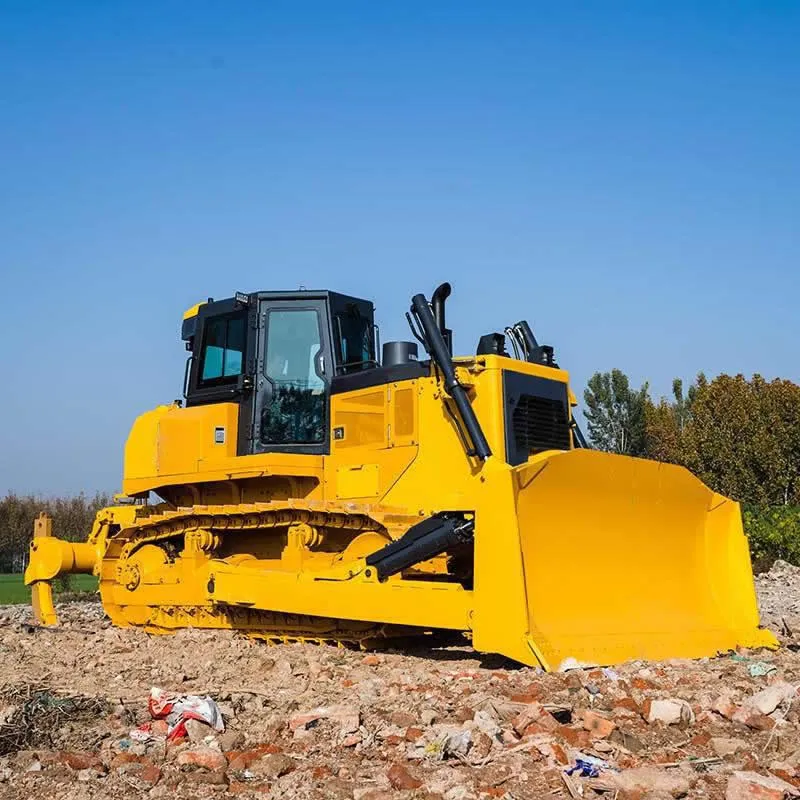
Bulldozers mainly consist of core components such as an engine, transmission system, walking system, working device, and electrical system. Their working principle is that the engine drives the hydraulic system, transmitting power to the walking mechanism and working device to achieve bulldozing operations. Modern bulldozers mostly adopt a hydraulic-mechanical transmission system; in models with power greater than 120KW, the combination of a hydraulic torque converter and a power shift gearbox has become standard configuration.
2.1 Pre-Work Inspection
Exterior Inspection: Surround the equipment to check for damage, deformation, or missing parts. Confirm the paint job is intact and all connections are secure.
Fluid Check: Confirm the fuel tank is full and free of impurities, the engine oil level is within the acceptable range on the dipstick, and the coolant level is normal.
Hydraulic System: Check the hydraulic oil tank level is appropriate, there are no leaks in the oil lines, and the joints are secure.
Electrical System: Ensure the battery is fully charged, the terminal blocks are clean and secure, and all vehicle lights are functioning normally.
2.2 Monitoring During Operation
Instrument Monitoring: Continuously monitor parameters such as the water temperature gauge, oil temperature gauge, oil pressure gauge, and ammeter.
Abnormal Sounds: Pay attention to engine noise, transmission system noise, and hydraulic system noise. If any abnormalities are found, stop the machine immediately and check.
Load Control: Avoid prolonged overload operation; select appropriate operating gears and speeds.
2.3 Post-Work Maintenance
Machine Cleaning: Thoroughly clean mud and dust using a high-pressure water gun, paying special attention to the radiator, engine compartment, and tracks.
Vacuum Parts Inspection: Inspect the wear of blades, track shoes, track rollers, etc., and replace them promptly.
Lubrication Maintenance: Apply grease to all lubrication points according to the lubrication chart.
|
Maintenance level |
China's large and medium-sized bulldozers |
Chinese small bulldozers |
Other foreign bulldozers |
|
One guarantee |
Every 200 hours of work |
Every 600 hours of work |
250 working hours |
|
Second guarantee |
Every 600 hours of work |
Every 1200 hours of work |
Every 1000 hours worked |
|
Three guarantees |
Every 1800 working hours |
- |
Every 2000 hours worked |
Regular Maintenance Content:
Engine System: Change engine oil and oil filter; check air filter; clean or replace filter element.
Hydraulic System: Check oil level and quality; change hydraulic oil and hydraulic filter.
Traverse System: Check track tension; adjust idler wheel position; lubricate track rollers and carrier rollers.
Electrical System: Check circuit connections; clean wiring terminals; test the function of all sensors.
4.1 Engine Overheating
Diagnostic Methods: Check coolant level and quality; test cooling fan, water pump, and thermostat functions.
Troubleshooting: Top up or replace coolant; clean radiator; repair thermostat and water pump.
4.2 Hydraulic System Faults
Diagnostic Tools: Use a pressure gauge to check system pressure; compare with standard values to determine the fault location.
Typical Problems: Overheating oil, insufficient pressure, sluggish operation, etc. Check oil quality, filter, and hydraulic components.
4.3 Track System Abnormalities
Rail Wear: Adjust the positions of drive wheels, idler wheels, track rollers, and carrier rollers to ensure symmetrical center planes coincide.
Derailment: Check track tension; adjust idler wheel tappets and tension spring tension.
5.1 Engine Maintenance:
Use antifreeze in winter; check coolant regularly in summer.
Replace fuel filter every 500 hours; check valve clearance every 1000 hours.
5.2 Hydraulic System Maintenance:
Utilize load-sensitive technology to achieve on-demand pressure supply, reducing energy waste.
Regularly check hydraulic oil contamination levels and keep the system clean.
5.3 Walking System Optimization:
Maintain proper track tension (standard clearance 0.5-1.0mm).
Regularly rotate track pins and bushings to extend service life.
5.4 Electrical System Protection:
Regularly clean electrical components to prevent dust accumulation.
Check wiring insulation performance to prevent short circuits.
6.1 Winter Maintenance:
Change to low-pour-point diesel (5°C lower than ambient temperature).
Use winter-specific engine oil and check hydraulic system seals.
Install antifreeze devices for the radiator.
6.2 Summer Maintenance:
Enhance radiator cleaning to prevent overheating.
Check the air conditioning system to ensure effective cab cooling.
Systematic maintenance can significantly extend the bulldozer's service life, reduce failure rates, and ensure construction efficiency. It is recommended to establish equipment maintenance records, documenting each maintenance procedure and troubleshooting, to provide a reference for subsequent maintenance.

