
Spider cranes (also known as spider hoists), as specially designed lifting equipment, are widely used in space-constrained and complex terrain environments due to their compact structure and high mobility, demonstrating irreplaceable value in such situations. Especially in urban construction, mining, ports, and work sites with challenging terrain, spider cranes offer unparalleled flexibility and adaptability compared to traditional cranes. However, despite their excellent performance in complex environments, operators must pay special attention to the following key aspects to ensure safe and efficient operation.
Spider cranes often operate in confined or uneven terrain. Operators should conduct a thorough inspection of the work site before operation. Particular attention should be paid to:
Ground Load Capacity: Although spider cranes have strong mobility, their operational stability is still limited by the ground load capacity. Operators should ensure that the ground is firm and level, avoiding operation on soft, slippery, or muddy ground to prevent the crane from tilting or slipping.
Obstacle Clearance: Check the work site for potential hazards such as obstacles and underground facilities, especially in confined spaces or around buildings. Ensure there are no objects obstructing operations.
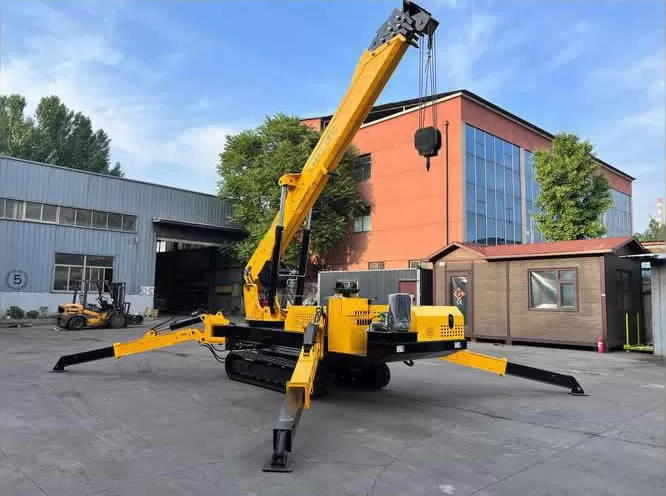
Spider cranes, named for their extendable outriggers, have the following significant features:
Compact and Flexible: The outriggers retract during transport, resulting in a compact structure that easily navigates narrow streets and indoor spaces.
Stable Support: The outriggers extend a large span (typically 3-4 meters) during operation, providing strong stability.
Multiple Power Options: Equipped with electric (low noise), diesel (powerful), and other power modes to adapt to different environmental needs.
Ground Adaptability: Lightweight and with distributed pressure from the outriggers, it can operate safely on fragile surfaces (such as wooden platforms or the ground of historic buildings).
Lifting Capacity: Despite its compact size, it can lift 1-10 tons, with a lifting height of 5-16 meters and a working radius of 5-12 meters.
Typical Application Scenarios in Complex Environments
|
Application scenarios |
Specific assignment content |
|
Urban redevelopment |
Material hoisting and roof repair in old residential areas |
|
Commercial venues |
Shopping mall lighting installation and ceiling repair |
|
Public facilities |
Venue equipment maintenance, high-speed railway station air conditioning repair |
|
Construction |
High-rise curtain wall installation and steel structure construction |
|
Municipal Engineering |
Tree trimming and street light maintenance |
The outriggers of a spider crane are crucial for ensuring operational stability. In complex environments, operators should pay special attention to the following:
Outrigger Extension and Leveling: When working on uneven ground, operators must ensure the spider crane's outriggers are fully extended, and the outrigger pads must be placed on a solid surface to prevent the outriggers from sinking or slipping during operation.
Dynamic Stability Check: During operation, operators need to constantly monitor the machine's stability, especially in windy conditions or when the load changes. The dynamic stability of the spider crane is critical for safety, and operators should avoid overloading.

When operating a spider crane in complex environments, load and working angle control are critical. Operators should follow these precautions:
Load Limitation: Operators should select the appropriate load based on the spider crane's rated lifting capacity and the operating environment to avoid overloading, which could cause the crane to tilt or be damaged.
Working Angle Control: The working angle is especially important when working in confined spaces or at heights. Operators must strictly adhere to the crane's operating angle limits to avoid instability caused by excessive angles.
When working at heights, spider crane operators must pay special attention to the following safety precautions:
Operator Personal Protective Equipment: Operators must wear appropriate safety harnesses when working at heights, ensuring secure anchoring under all circumstances.
Environmental Monitoring: Operators need to monitor changes in the surrounding environment, including wind speed and weather conditions, and avoid working at heights in inclement weather.
6.1 Pre-Operation Preparation
Ground Assessment: Check the ground's load-bearing capacity to ensure it can withstand the crane's ground pressure (typically 36 kPa);
Outrigger Inspection: Confirm that the outriggers are fully extended and stable, with a distance of 4.04 m (width) × 3.47 m (length) between the two outriggers;
Safety Devices: Test the torque limiter, anti-tilt device (3°), alarm system, etc., to ensure they are functioning properly.
6.2 Key Points for Operation
Load Control: Overloading is strictly prohibited; the lifting capacity must always be within the rated range.
Environmental Monitoring: Pay attention to wind speed (operation should be stopped in winds exceeding level 6) and changes in ground conditions.
6.3 Operating Procedures:
Maintain the balance of the load and avoid sudden movements.
Plan a clear lifting path, avoiding obstacles.
Use the luffing indicator to monitor the operational status.
The spider crane is designed to operate in complex terrain; however, special caution is still required under certain conditions:
Wet and Muddy Ground: In rainy seasons or wet and slippery environments, operators should avoid rapid movement to prevent the machine from losing control due to unstable ground.
Steep Slope Operation: When operating on steep slopes or uneven surfaces, operators should ensure the spider crane remains balanced at all times to prevent tipping due to an unstable center of gravity.
In complex environments, emergencies such as equipment failure or sudden weather changes may occur during operation. Operators should possess the ability to respond quickly:
Equipment Failure Handling: When a spider crane malfunctions, the operator should immediately stop operation, troubleshoot the problem, and notify relevant technical personnel.
Emergency Weather Response: In case of severe weather such as strong winds or heavy rain, the operator should evacuate the work site promptly and ensure the crane is safely parked.
The efficient operation of a spider crane relies on daily maintenance and upkeep. Operators should regularly inspect and maintain key components:
Hydraulic System Inspection: The hydraulic system is a crucial component of a spider crane. Operators need to regularly check the oil quality and pressure to prevent hydraulic failures from affecting operations.
Tire and Track Inspection: For wheeled spider cranes, operators should check tire pressure and wear; for tracked cranes, they should check track tension and condition to prevent malfunctions.
Operating with spider cranes in complex environments is challenging, but through strict operating procedures, comprehensive safety measures, and regular equipment inspections, operational safety and efficiency can be effectively ensured. Operators should be proficient in understanding the equipment's characteristics and perform proper daily maintenance. Operators must remain vigilant at all times, adhere to safe operating procedures, and ensure that the spider crane can operate smoothly under various complex working conditions.

