
An excavator quick coupler is a mechanism that allows excavators to quickly change work attachments (such as buckets, breakers, and grapples) without manually removing connecting pins. It improves equipment deployment efficiency, reduces manual intervention and downtime, but its complex structure and heavy load-bearing capacity mean that improper maintenance can lead to safety risks and high repair costs.
A quick coupler generally includes a locking mechanism, locating pins, hydraulic connection (or manual pins), bearings, and sealing components. Normal operation depends on the reliable engagement and smooth movement of these components, which requires maintenance personnel to strictly perform regular inspections and lubrication.
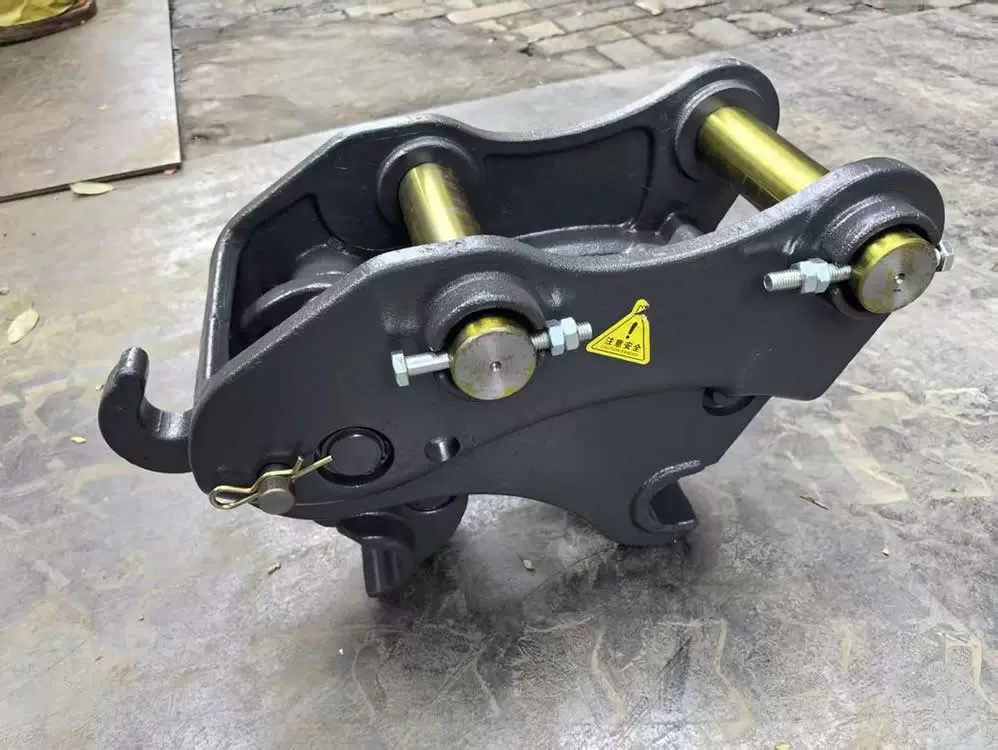
Quick couplers are mainly divided into two types, which require different maintenance approaches:
|
type |
Structural features |
Working principle |
Maintenance focus |
|
Hydraulic |
Includes hydraulic cylinder, locking tongue, safety pin, and sealing ring. |
The hydraulic cylinder extends and retracts, driving the locking tongue to rotate and clamp/release the attachment pin; this, combined with a manual safety pin, provides double safety. |
Cylinder seals, pipeline leaks, hydraulic oil contamination |
|
Mechanical |
wedge block, bolt, spring, clip |
Manual operation of the bolt-driven wedge block for locking relies on mechanical preload. |
Bolt tightening, pin wear, spring fatigue |
2.1 Environmental Cleaning and Visual Inspection
A quick inspection before and after each operation can prevent more than 90% of sudden failures. After turning off the engine and ensuring the excavator is in a stationary and safe state, first clean the quick coupler surface of mud, dust, concrete residue, and other foreign matter. Cleaning prevents impurities from embedding in moving parts, causing wear or jamming.
Then perform a visual inspection:
Check for cracks, bending, or weld damage in the quick coupler structure;
Check if the locking mechanism's pins and springs are intact and secure, without looseness or breakage;
Check for obvious corrosion, deformation, or excessive clearance in movable parts.
This inspection is recommended before each day's work, and any problems found should be recorded.
2.2 Quick Lubrication of Lubrication Points
Lubrication is a core method for extending the life of the quick coupler; incorrect lubrication is more harmful than no lubrication. Daily lubrication focuses on all moving hinges, pins, locking pin surfaces, and guide sliding surfaces. According to the equipment manual, lubrication should be performed at least after each work shift or daily; some manuals recommend lubrication every 40 operating hours. Lubrication Procedure:
Cleaning: Thoroughly wipe the grease nipples and surrounding areas with a lint-free cloth to remove grease and dirt;
Greasing: Using a manual grease gun, inject grease into each grease nipple 3 times (approximately 15g/time);
Actuation: After greasing, repeatedly operate the quick-change device switch 3-5 times to evenly distribute the grease to the pins and bushings;
Overflow Check: Observe whether new grease slightly seeps out from the seal. If not, it indicates that the interior is not fully filled and requires additional greasing;
Cleaning Excess Grease: Wipe off any excess grease with a cloth to prevent dust accumulation and the formation of abrasive paste.
Lubricant Selection Recommendations
|
Environmental conditions |
Recommended grease type |
Feature Description |
|
General operating conditions |
NLGI Grade 2 lithium-based grease(such as Shell Alvania RL2) |
Temperature resistant from -20℃to 130℃, good water resistance, and high cost performance. |
|
High temperature/high dust |
Extreme pressure anti-wear lithium-based grease(such as Mobil SHC 634) |
Contains molybdenum disulfide, has a high abrasion resistance index, and can withstand continuous high temperatures of 150°C. |
|
Damp/Watery |
Complex lithium-based grease + rust inhibitor(such as Castrol Lubricor 2) |
It has strong anti-emulsification properties and excellent rust prevention performance. |
|
Mixing is strictly prohibited. |
Different brands and types of grease |
Mixing them may cause a chemical reaction, resulting in the hardening and loss of the grease. |
|
part |
Change threshold |
Detection methods |
Remark |
|
Pin bushing |
Inner diameter wear ≥2mm, or obvious elliptical deformation. |
Use an inside micrometer to measure, or insert a feeler gauge to check the gap. |
Replacement should be done in pairs to avoid poor compatibility between the old and new parts. |
|
Hydraulic cylinder seals |
Oil seepage, oil dripping, or slow retraction of the hydraulic cylinder may occur. |
After disassembly, check whether the sealing lip is flared or cracked. |
We recommend using the original manufacturer's sealed packaging to avoid counterfeit products. |
|
Safety pin |
Surface cracks, deformation, and wear exceeding 10% |
Diameter measured visually and with calipers |
High-strength alloy steel components must be used; welding repairs are prohibited. |
|
Connecting bolts |
Thread stripping, deformation, or length shortening ≥3% |
Use a thread gauge to check, or compare with a new part. |
It is recommended to use high-strength bolts of grade 8.8 or higher; ordinary bolts are prohibited. |
|
Error behavior |
as a result of |
Correct approach |
|
Hydraulic lines were disassembled without depressurization. |
High-pressure oil injection caused serious injury. |
Turn off the engine before operation and repeatedly operate the control lever to release pressure. |
|
Install by hammering the pin. |
This caused deformation and cracks in the quick-change device frame. |
Use a copper rod or a special pressing tool. |
|
Do not clean the grease nipple before lubrication |
Impurities entering the interior accelerate wear. |
It must be wiped with a cotton cloth; direct injection of grease is strictly prohibited. |
|
Mixing different brands of grease |
Oils and fats undergo chemical reactions, leading to clumping and loss of effectiveness. |
Strictly use the same brand and model to thoroughly remove old grease. |
|
Ignoring the use of safety pins |
Accessories may accidentally detach, endangering personal safety. |
After each attachment installation,the safety pin must be inserted and locked. |
For excavator operators, correctly inspecting and lubricating the quick-change device not only extends equipment life and improves reliability, but is also an important guarantee for operational safety. Following a systematic maintenance process of daily cleaning, regular greasing, structural inspection, and functional testing can minimize the risk of unplanned downtime and provide a solid foundation for stable equipment operation. Systematic inspection and lubrication methods are not just "operating procedures"; they are the core of reliable maintenance.

