
With their unparalleled road maneuverability, rapid relocation capabilities, and relatively low ground damage, wheeled excavators have become a mobile workhorse in numerous fields, including earthmoving, municipal construction, agricultural and forestry reconstruction, and disaster relief. In mines, construction sites, roads, and municipal construction, wheeled excavators have become a common operating equipment due to their maneuverability and adaptability.
However, their unique wheeled travel structure and high center of gravity also place higher demands on the operator's skills, experience, and safety awareness in complex operating conditions. From a professional perspective, this article systematically summarizes the operating precautions for wheeled excavators in different operating conditions, combining their structural characteristics and typical operating conditions. This information is suitable for publication in the excavator section and serves as a reference for operators, equipment managers, and project engineers.
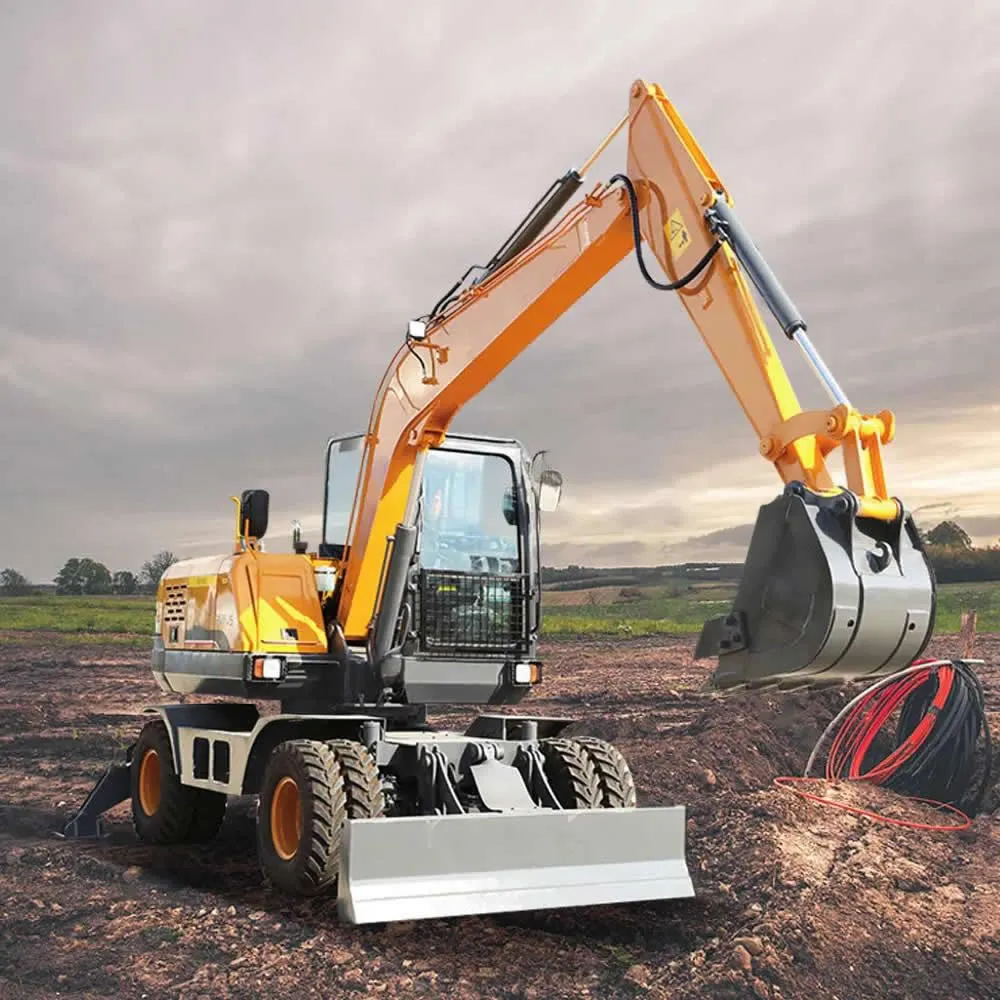
Before delving into operating precautions, let's briefly review the structural characteristics, applicable scope, and limitations of wheeled excavators.
1.1 High Maneuverability, Suitable for Road/Urban Operations
Compared to crawler excavators, wheeled excavators offer higher speeds on smooth, hard surfaces and greater ease of movement from one workstation to another.
Their tires, unlike steel tracks, do not cause significant damage to asphalt and pavement, making them an excellent choice for urban applications, road maintenance, pipeline laying, and other environments.
1.2 Higher Stability Requirements and More Significant Operating Conditions
Due to their smaller tire contact patch and generally higher center of gravity than crawler excavators, wheeled excavators offer less stability on slopes, soft soil, and in construction environments with potholes or loose foundations.
Also, the digging depth and lateral excavation capabilities of wheeled excavators may be slightly inferior to those of crawler excavators of the same tonnage.
1.3 Outrigger/Support Structure Usage is Critical
For many skidding, digging, and loading tasks, wheeled excavators require outriggers or counterweights to achieve stability similar to that of crawler excavators.
Therefore, based on the above structural and operating characteristics, wheeled excavator operating precautions in different operating environments must prioritize stability, safety, adaptability, and energy efficiency.
The following is a categorization of common operating conditions (road/urban operations, soft soil/wetland operations, slope/side slope operations, and loading/lifting/material handling operations), with key precautions for each category identified before, during, and after operation.
2.1 Road/Urban Construction Conditions (Pipeline Excavation, Road Maintenance, Urban Construction)
Before Operation
Conduct a thorough survey of the work area to confirm the road's load-bearing capacity, the location of underground pipelines, cables, communication lines, and any potholes and obstacles. If operating on public roads or narrow lanes, set up warnings and conduct traffic diversion in advance.
Check tire pressure, tire wear, and wheel hub structure to prevent blowouts and slippage. For wheeled excavators, special precautions should be taken, as tires are more susceptible to punctures and damage from foreign objects.
Before starting, perform a thorough inspection of the following: engine oil, hydraulic oil, coolant, grease, outrigger structure, operating mechanism, alarm system, lights, and mirrors.
During Operation
When operating on hard surfaces, avoid raising the boom or extending the work attachment for movement, as this will raise the center of gravity and reduce stability.
When moving from one work location to another, prioritize wheeled operation with the swivel mechanism locked or the outriggers retracted to ensure stable operation.
If outriggers are required during operation, ensure they are fully extended, pressed down, and firmly grounded to prevent unilateral sinking and causing the machine to tilt.
When operating in urban areas or on paved roads, pay attention to changes in friction between the tires and the road surface. Avoid sharp turns, large swing angles, or high-speed swivels, as these may cause tire slippage or vehicle instability.
When operating at the edge of the work area or near a roadway, pay special attention to pedestrians, vehicles, and obstacles when swivels are in place. Wheeled excavators can swivel quickly and react sensitively, so advance warning is essential.
After Operation
Fully retract the excavation equipment (e.g., bucket and boom) to a safe position, retract and lock the outriggers, shift the gear to park, and apply the parking brake.
Clear any foreign matter (e.g., rocks, bolts, and nails) from the tires and inspect their condition for the next operation.
After stopping the machine, record mileage and tire wear to provide data for subsequent maintenance.
2.2 Soft Ground/Wetland/Weak Foundation Conditions
Before Operation
Perform a preliminary test of the foundation's bearing capacity: Use a bucket or probe to determine the softness, groundwater level, and potential subsidence.
Ensure that the outriggers or auxiliary support devices, such as steel plates, temporary paving, or reinforcement plates, are available to reduce the risk of tipping or sinking of the wheeled equipment on soft ground.
Check that the tires are suitable for soft ground operation (e.g., whether they are wide, low-pressure, equipped with floating wheels, and equipped with snow chains).
During Operation
Avoid frequent pivoting or wide-angle lateral excavation on soft ground, as wheeled machines have less lateral stability than crawler machines on soft ground.
Excavate as close to the machine body as possible, minimizing boom extension to prevent forward or lateral shifting of the center of gravity.
When driving or relocating, maintain a low speed and avoid excessive tire rotation to prevent slipping or sinking.
If a tire sinks or the machine tilts, stop operation immediately and apply steel plates, blocks, or other reinforcement measures before continuing.
After Operation
Park on stable, compacted ground to avoid sinking. Before retracting the outriggers, ensure the ground is stable.
Clear away dirt, moisture, and debris from the tires and around the outriggers, and inspect the tire sidewalls for cuts or erosion by sharp objects.
After working in water or wetlands, inspect the axles, steering mechanism, waterproof seals, and electrical components for moisture.
2.3 Slope/Slope Working Conditions (Leveling, Cutting, and Excavating Slopes)
Before Operation
Carefully confirm the slope angle, whether the foundation is loose, and whether there are any risks of falling rocks or landslides. Select a safe angle with an appropriate slope and away from cliffs.
If necessary, use outriggers, ramp pads, temporary ramp reductions, and safety railings based on the slope.
Post work boundary signs to clearly prohibit unauthorized personnel from entering the danger zone.
During Operation
When operating or driving on a slope, the excavator (boom, bucket) should be positioned below the center of gravity of the machine to avoid raising the boom, which would shift the center of gravity upward.
Prioritize working along a vertical or downhill slope. Avoid sideways excavation or extended boom extensions, as these tend to reduce lateral stability.
When using outriggers, ensure they are evenly connected to the ground and do not slip. Avoid large swings and sudden stops during operation to prevent the machine from tipping over.
When excavating a slope, maintain a certain distance from the toe of the slope and do not extend the bucket too far in front of the excavator to prevent ground collapse or excavation-induced slope collapse.
After Operation
After shutting down the excavator, retract the machine to its safest position, ensuring that the excavator is parked in a stable position and the slope is stable.
Clean the slope surface under the excavator where the tires and outriggers come into contact, confirming there are no signs of sinking or slippage.
Track and record changes in the slope inclination and machine tilt angle to provide a basis for the next operation.
2.4 Loading/Lifting/Material Handling Operations
(e.g., loading excavated materials onto a truck, lifting rocks, handling waste, etc.)
Before Operation
Check that the surface of the lifting or loading area is level and stable, and that there are no personnel, equipment, or obstacles nearby.
Check that the excavator is equipped with suitable equipment for lifting or handling operations (such as quick-change couplings, grab bucket, or bucket with hook) and confirm their safety.
Estimate the load weight, boom length, lifting height, and lifting radius to avoid overloading or exceeding the machine's specified range.
During Operation
During lifting and loading, select "slow mode" and move slowly and smoothly, avoiding sudden lifting or turning.
When using a wheeled excavator for lifting, it is recommended to retract the outriggers and ensure the machine body is locked to prevent slippage during lifting.
When traveling or transporting a load, avoid high speeds, sharp turns, or tilting, and ensure the center of gravity is always within the support surface. If movement is necessary, first lower the load to the lowest safe height.
When loading onto a truck or unloading into a bulk pile, control the range of motion of the bucket or boom to avoid throwing the load away from the center of the machine body and causing it to overturn.
After Operation
After unloading, release the load, return the hook to its original position, and return the outriggers or support system to normal operation.
Inspect the lifting device, quick changer, bucket mouth, grab, etc. for fatigue, cracks, or deformation.
Record the number of lifts, lifting height, radius, and load to provide data for future maintenance and load assessment.
In addition to operating points specific to specific operating conditions, there are a series of "General Precautions" applicable to all wheeled excavator operating conditions, focusing on safety, equipment lifespan, and energy conservation:
3.1 Familiarity with the Control System and Model Features
Operators should be proficient in the excavator's control modes, such as the common ISO and SAE joystick layouts. They should also familiarize themselves with driving gears, outrigger control, swivel lock, and travel modes according to the manufacturer's manual.
3.2 Daily Inspection and Maintenance
Before each operation, perform a daily inspection of the following: hydraulic oil, engine oil, coolant, tire pressure, outrigger mechanism condition, bucket/grab wear, and operator's platform safety devices (seat belts, side mirrors, warning lights).
Regularly lubricate, replace filters, and inspect the hydraulic system to extend equipment life and reduce failure rates.
3.3 Controlling the Center of Gravity and Stability
Regardless of the operating conditions, always pay attention to the center of gravity of the excavator during operation: avoid swinging the boom high while moving, extend the bucket too far, rotate slowly, and avoid operating with the outriggers partially grounded.
3.4 Adapting to Ground Conditions and Environmental Changes
Wheeled excavators are sensitive to ground flatness and load-bearing capacity. When encountering rain, soft soil, gravel, or potholes, reduce operating intensity, minimize lateral movement, and plan escape routes.
3.5 Energy Saving and Efficiency Optimization
Wheeled excavators offer significant energy-saving advantages due to their high speed and ease of maneuverability. When not excavating, operate in "drive mode" rather than idling. Also, optimize operating times and avoid frequent starts and stops to reduce fuel consumption and mechanical wear.
3.6 Operator Training and Safety Awareness
Even if the equipment is equipped with advanced safety systems (such as rearview cameras and collision warnings), operators must still maintain risk awareness: prohibit unauthorized personnel from entering the operating radius, sound the horn/warning signal before turning, and establish perimeter barriers and safety reminders around the work area.
Given that our company (Wendy Vehicles) primarily operates in Africa, the Middle East, and several Stan countries, the following special considerations should be taken into account when operating wheeled excavators in these regions:
Ground Foundation Differences: In many areas of the Arab, Middle Eastern, and African regions, the ground may be sandy, gravelly, or easily loosened due to rainfall and drought. Therefore, a ground assessment and temporary planking or outrigger padding should be performed in advance.
Climate Environment: Due to the frequent occurrence of high temperatures, dust, and storms (such as sandstorms), tires, hydraulic system seals, and dust filters require increased maintenance. Dust covers and cabin filters must be replaced promptly when the machine is shut down.
Transport and Rapid Mobility Needs: In large-scale industrial and mining environments, wheeled excavators' road-mobility capabilities are an advantage. Plan the unit's movement routes between work sites to avoid wasted long, non-operational distances.
Spare Parts and Maintenance Supply: Since maintenance resources may be limited in remote areas, select models that are easily repairable and have readily available tires and parts, and train local operators and maintenance personnel.
Language and Training: Operating manuals and training materials should consider local languages (such as Arabic, Russian, and Uzbek) and cultural differences to ensure compliance with safety regulations.
Wheeled excavators play a vital role in modern construction due to their maneuverability, efficiency, and suitability for road, urban, and inter-project operations. However, they also place higher demands on the operating environment and operators in terms of stability, ground compatibility, and operational safety. Mastering key operating principles in various working conditions—particularly stable outrigger application, precise center of gravity control, constant environmental observation, and specialized techniques for specific tasks (such as pipeline excavation, crushing, and ramp operations)—is fundamental to ensuring human and machine safety, improving operational efficiency, extending equipment life, and safeguarding corporate reputation.
This article, analyzing structural characteristics, typical operating conditions, operational details, and cross-border application, will help equipment managers and operators gain a more systematic and professional understanding of wheeled excavator operating precautions in various working conditions, thereby enhancing safety, increasing equipment utilization, and reducing failure rates.

