
Tractor-trailer combinations are one of the most common heavy-duty equipment used in road transport. When the load is significant, the stability, braking performance, and handling of the entire tractor-trailer combination change significantly. To ensure the safety of heavy-duty towing and improve operational standards, this guide, based on the specifications of the Chinese Ministry of Transport, mainstream manufacturer technical manuals, and real-world accident cases, selects key operational points and describes the basic towing and coupling techniques for tractors and trailers. It is applicable to frontline tractor drivers and fleet managers.
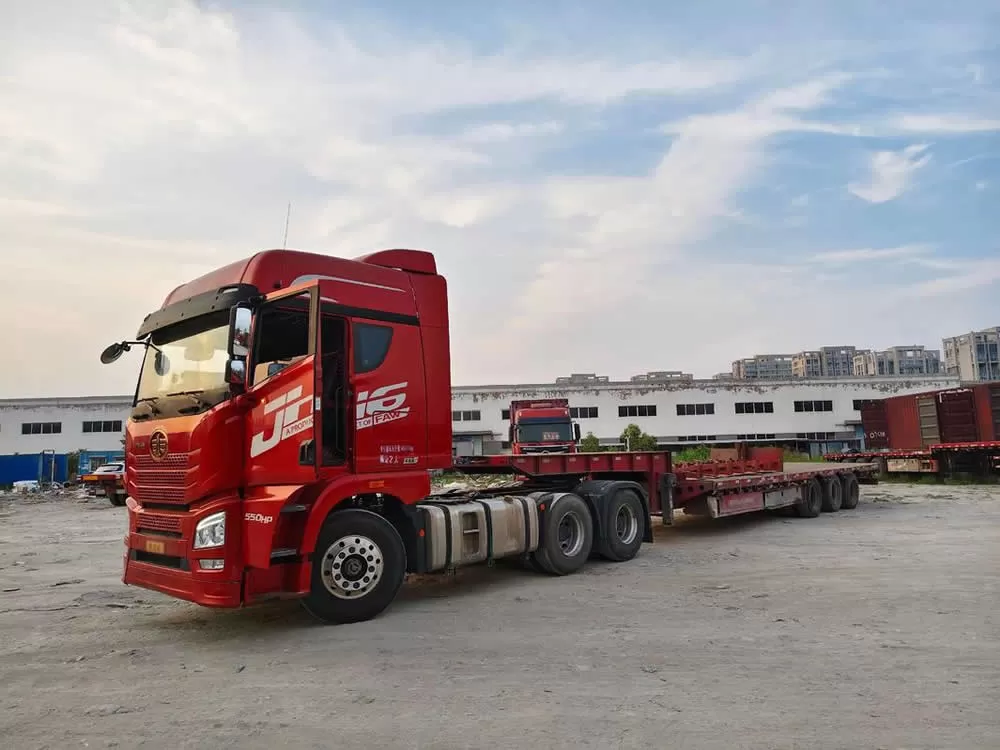
Heavy-duty towing is not simply a matter of "connecting the trailer and driving away"; it requires a series of rigorous preparations. The safety of heavy-duty towing begins with a systematic inspection before connection. Any oversight can lead to catastrophic consequences.
1.1 Trailer Support Leg Adjustment
Operate on a flat surface, ensuring the trailer's parking brake is engaged, and secure the wheels with wheel chocks. Adjust the height of the support legs so that the gap between the kingpin coupling surface and the fifth wheel base surface is maintained at 50–80mm to avoid lateral force imbalance during connection.
1.2 Fifth Wheel Opening and Center Alignment
Lift the fifth wheel handle to the locked position and confirm the open state. When reversing to connect, the trailer's centerline must be perfectly aligned with the tractor's centerline. Misalignment will cause the support legs to bear abnormal lateral loads, which can easily lead to structural fatigue and fracture.
1.3 Air and Electrical Connections
Air lines: Connect the tractor's red (parking brake) and blue (control) air lines to the corresponding interfaces on the trailer. Incorrect connection is strictly prohibited. After connection, open the brake isolation switch behind the cab and confirm that the air pressure gauge rises to the rated value (not less than 0.8 MPa).
Electrical connections: When connecting the trailer's electrical interface, align the male and female connectors and insert them completely, then cover with the protective cover. If the trailer is equipped with ABS, the ABS wiring harness must be connected simultaneously.
International Standard Basis: Electrical interfaces must comply with ISO 11992 specifications to ensure stable CAN bus communication and prevent loss of braking signals.
1.4 Brake System Inspection
Braking distance increases significantly under heavy load compared to unloaded conditions; therefore, the braking system (including brake pads, air pressure system, and ABS status) must be thoroughly inspected. Ensure sufficient air pressure, no leaks, and responsive braking.
1.5 Locking Mechanism Confirmation
Check that the fifth wheel coupling jaws are fully closed and the locking pin is secure. Visual inspection alone is strictly prohibited; the trailer kingpin must be manually shaken to confirm there is no movement.
1.6 Retracting Support Legs and Releasing Parking Brake
Only after confirming that the air and electrical systems are working correctly should the trailer support legs be retracted, the wheel chocks removed, and the trailer parking brake released.
1.7 Operating Mantra:
“Adjust legs, align, connect air, connect electricity, lock, check pressure, retract legs, release brake”
Under heavy load, vehicle dynamic response is slow, and the margin for error is extremely low.
|
Security Dimensions |
Operating requirements |
Risk Warning |
|
Vehicle speed control |
Speeds must be reduced by at least 50%on curves, slopes, and in rainy or foggy weather. |
Speeding is the main cause of rollovers. In several accidents in 2024, vehicles traveling at 52 km/h through curves with a speed limit of 40 km/h caused their center of gravity to shift and lose control. |
|
Braking operation |
Employpredictive brakingto avoid sudden braking. Utilize the engine retarder to assist deceleration and reduce the load on air brakes.Continuous intermittent braking is strictly prohibitedto prevent sudden drops in air pressure that could lead to brake failure. |
Unsynchronized braking is a direct cause of trailer dragging and fishtailing. |
|
Turning and changing lanes |
When turning, use a "wide entry and wide exit" strategy, leavingextra space for the inner wheel difference(at least 1 meter more). Before changing lanes, check the blind spot and confirm that there are no vehicles 300 meters behind you. |
Heavy-duty trailers have a turning radius 30%–50% larger than ordinary vehicles, and forcibly changing lanes can easily cause them to scrape guardrails or adjacent vehicles. |
|
Driving on a slope |
Uphill: Shift to a lower gear in advance andclimb the slopeto avoid stopping midway. Downhill: Shift to a low gear anddo not coast in neutral; use engine braking. |
Overloading combined with downhill neutral gear leads to overheating and brake system failure, resulting in multiple rear-end collisions. |
|
Cargo loading |
Strictly adhere toloading requirements; the total mass must not exceed the approved value (e.g., 6×4 tractor + two-axle trailer ≤ 43 tons).The center of gravity of the cargo must be centered and evenly distributed; it is strictly forbidden to load the cargo too heavily in the front or too lightly in the back, or to load it unevenly. |
If the load exceeds 30%, the braking distance increases by 40%, and the steering response is delayed by more than 2 seconds. |
3.1 Key Points for Reversing
Slow speed, minimal steering: Control reversing speed to 3–5 km/h, and turn the steering wheel no more than 1/4 turn at a time to avoid jackknifing the trailer.
Multiple mirror observation: Use the left and right rearview mirrors and the interior rearview mirror simultaneously; use ground personnel for guidance if necessary.
Predict the trajectory: Imagine the movement trajectory of the trailer's rear end, "where the truck goes, the trailer follows," and leave sufficient space in advance.
3.2 Reversing Mantra:
“Slow, look, minimal steering, listen to instructions, observe trailer swing, truck direction is key”
3.3 Emergency Procedures
Trailer detachment/rollover: Immediately activate hazard lights, do not brake suddenly, gently apply brakes to slow down, and pull over to the side of the road. Set up warning triangles (no less than 150 meters), evacuate personnel, and call for help.
Air leak: If a "hissing" sound is heard, stop immediately. Close the tractor's brake isolation switch, and do not continue driving. Electrical Interruption: If all trailer lights go out, immediately stop and check the connector. If this happens while driving at night, you must immediately pull over.
|
Accident Types |
direct cause |
as a result of |
|
Trailer tire detached |
The wheel hub bolts were not tightened to the specified torque and loosened due to long-term vibration. |
The 2022 accident on the Qingyin Expressway resulted in 5 deaths and 1 injury; a tire rolled 500 meters, triggering a chain collision. |
|
Heavy-load rollover |
Speeding (52km/h) + Overloading + Sharp Turn |
In 2024, speeding was a common factor in 90% of rollover accidents. |
|
Incorrect gas connection |
The driver mistakenly swapped the red (parking) and blue (control) air hoses. |
The trailer's parking brake failed to release, causing it to be dragged while driving, resulting in a broken axle. |
|
Connection not locked |
The saddle gripper closure was not manually confirmed. |
The trailer detached while driving, and the tractor lost control and crashed into the guardrail. |
This guide's operating procedures are consistent with the following international standards, ensuring technical compliance:
Mandatory requirements for the mechanical connection strength and locking device reliability of tractors and trailers.
Digital communication protocol (CAN bus) between tractors and trailers, ensuring real-time synchronization of braking and ABS signals.
Lateral stability test benchmarks for towing systems, guiding vehicle design and load distribution.
China's "Regulations on the Technical Management of Road Transport Vehicles" (Ministry of Transport Order No. 3, 2023) clearly requires that: all tractor and trailer connection devices, brakes, and lights must comply with national standards; otherwise, a road transport permit will not be issued.
Please remember the following prohibitions to avoid causing major accidents due to habitual errors:
Avoid: Starting without checking the air and electrical circuits
Avoid: Overloading or oversized transport
Avoid: Not leaving enough space for the inner wheel during turns
Avoid: Coasting downhill in neutral
Avoid: Sudden acceleration and sudden braking
Avoid: Judging the connection security solely by feel
Avoid: Starting before the air pressure reaches 0.8 MPa
Avoid: Driving at night with incomplete lighting
Avoid: Not retracting the support legs after connecting the trailer
Avoid: Panicking and making sudden steering movements in emergencies
As a professional operator, your reaction speed and judgment are the last line of defense for safety:
7.1 Brake Failure or Delayed Braking
If the braking response is sluggish, first gradually reduce speed to a safe speed, then use engine braking in conjunction with the brakes to slow down and find a safe place to stop.
7.2 Rear Sway or Tail Swing Phenomenon
If the trailer sways or swings uncontrollably, reduce steering, brake moderately, and slowly stop under safe conditions to check the trailer's condition. 7.3 Insufficient Air Pressure Alarm
If the brake air pressure is insufficient, the system may automatically shut down. In this case, you should immediately activate the emergency brake, stop the vehicle, and perform an inspection. Do not continue driving at high speed.
Operating a tractor-trailer under heavy load is a complex skill that combines technology, experience, and risk awareness. Adhering to operating procedures, meticulously checking every aspect, and maintaining stable driving habits are fundamental to ensuring the safety of heavy-duty transportation. As vehicle safety technology standards continue to improve, understanding and implementing these technical guidelines will significantly reduce accident risks and improve transportation efficiency for professional operators on the front lines of operations.

