
Manual hydraulic pallet trucks are the most common handling equipment in warehouses, logistics, and production workshops. They are simple in structure and easy to operate, effectively improving handling efficiency and reducing physical exertion. However, these devices are prone to wear, oil leaks, and component fatigue under high-frequency operation. Therefore, daily maintenance is crucial. Proper maintenance after each operation can extend the equipment's lifespan by more than 30% and prevent 80% of sudden failures. Maintenance is not only about extending equipment life but also a key aspect of ensuring operational safety.

After each operation, it is essential to perform a basic inspection and cleaning of the equipment. This is the most basic but often overlooked step.
First, the body and fork surfaces of the pallet truck should be cleaned. Dust and debris easily accumulate around the forks, steering wheels, and drive wheels. These foreign objects may jam the wheel axles or hydraulic structure during the next operation, affecting operational flexibility. It is recommended to wipe the equipment's exterior with a clean cloth, especially the wheel assemblies and rotating parts, to remove any attached debris.
Next, check the hydraulic system for external leaks. Leaks are often a sign of aging seals or cylinder wear. If oil traces or residue are found, record the location and check the condition of the seals and oil seals during scheduled periodic maintenance.
Finally, confirm that the forks have no obvious deformation, cracks, or twisting. The forks are the core load-bearing components; once deformed, they can cause uneven load distribution and increased load on the hydraulic system. In extreme cases, it may even cause safety accidents.
After each operation, the following procedures should be followed:
|
Operating steps |
Key points of implementation |
Engineer's Tip |
|
1. Forklift return to position |
Lower the forks to their lowest position, ensuring they are fully on the ground.Do not leave the vehicle suspended in the air. |
The suspended forks continuously compress the hydraulic system seals, accelerating seal aging and becoming the primary cause of "automatic descent" malfunctions. |
|
2. Parking without load |
Ensure the forklift is free of any load and release any residual pressure in the hydraulic system. |
Residual pressure will continue to act on the safety valve and relief valve, causing the valve core to stick or the spring to fail due to fatigue. |
|
3. Clean the vehicle body. |
Use a dry cloth to remove oil, water stains, and dust from the surfaces of the forks, wheels, handles, and hydraulic cylinders. |
In humid environments (such as cold storage facilities in Chongqing), oil stains + moisture = rapid corrosion; in dusty environments (such as building material warehouses), dust embedded in the axles = accelerated wear. |
|
4. Close the safety valve. |
Place the handle in the "neutral" position to ensure the hydraulic system is not in operation. |
To prevent accidental lifting caused by accidental operation of the handle, and to ensure the safety of subsequent workers. |
|
5. Record usage duration |
Record the cumulative duration of this operation on the equipment log card. |
This provides data for subsequent first-level maintenance (every 50 hours), preventing over-warranty or under-warranty maintenance. |
The hydraulic system is the core of the pallet truck; it determines the lifting performance and operational stability. Timely inspection after operation will greatly reduce the failure rate.
Performing oil checks and changes is one of my weekly tasks. The hydraulic oil must not only maintain an appropriate level but also its quality: discolored or contaminated oil should be replaced as soon as possible. According to the manufacturer's maintenance manual, the hydraulic oil should generally be replaced every 12 months. This oil change cycle maintains the viscosity and lubrication of the oil, reducing wear on the pump and cylinder. And the areas to check: the joint between the hydraulic cylinder barrel and piston rod, the threaded connections of the hydraulic pump's inlet/outlet ports, and the seal ring area of the handle control valve core. Wipe the suspected leakage points with a clean white cloth, let it sit for 5 minutes, and observe whether oil stains appear.
Air entering the hydraulic system is another common problem, which can lead to slow lifting or even operational failure. The method to eliminate air is to repeatedly operate the handle pump in the lowered position to expel the gas with the hydraulic fluid.
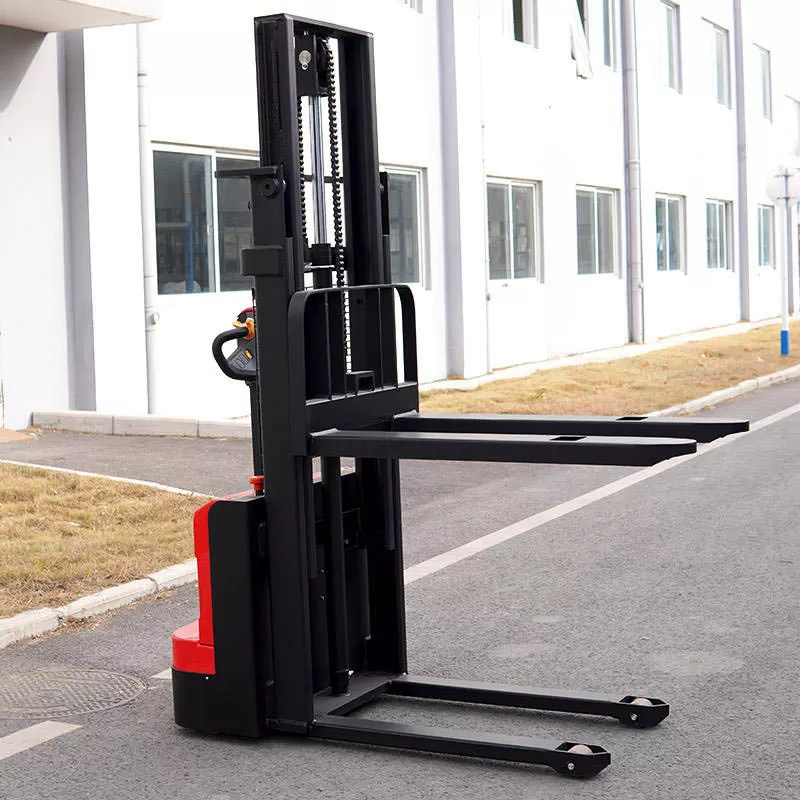
Many moving parts in the pallet truck, such as wheel axles, steering joints, and handle pivot points, require lubrication to ensure smooth movement.
Based on maintenance experience, applying grease (generally standard grease) to the wheel axles, steering bearings, and pivot points monthly can effectively reduce friction and noise.
In addition, do not overlook the linkage adjustment under the forks, as this affects the lifting consistency and load balance of the forks. Regularly adjusting the linkage according to the instructions will maintain the smooth operation of the forks.
For the assessment of fork deformation and wear, please refer to the table below:
|
Inspection items |
Qualification Standard |
Scrapping Standards |
|
curvature |
No visible bending |
Any point of bending exceeds 5mm |
|
Height difference between the two forks |
%of the horizontal segment length |
>3% (e.g., fork differential of 1000mm >30mm) |
|
Thickness wear |
90 %of original thickness |
Wear down to ≤90% of the original thickness (e.g., original thickness 12mm → ≤10.8mm) |
|
Weld and root |
No cracks, no solder detachment |
If any cracks appear,it is strictly forbidden to repair them by welding and continue using the product. |
The wheel assembly is a component that is frequently subjected to ground impact and load wear. After each operation, the wheels should be checked for cracks, significant wear, or sluggish rolling. Accumulated dust, threads, and other foreign objects stuck in the wheel axle gap can also affect rolling performance and should be removed promptly.
Check whether the front and rear wheels are stuck or making abnormal noises, whether the wheel axles are entangled with ropes, plastic straps, wires, or other foreign objects, and whether the tires (solid/pneumatic) have bulges, cracks, or exposed steel rims.
After confirming that the wheel axle mating parts are in good condition, it is even more important to check the bearing and wheel assembly wear every 6 to 12 months; if abnormal rolling sounds or noticeable eccentric rotation are found, the components should be disassembled, inspected, and worn parts replaced promptly to prevent failure under high load. The maintenance of lubrication points can be referred to in the following:
|
Lubrication parts |
Recommended lubricant |
Maintenance cycle |
Key points of operation |
|
Fork sliding rail |
ISO VG 32–46 Industrial Hydraulic Oil |
Once a month |
Apply a thin layer after cleaning to avoid dust accumulation. |
|
Front and rear axle bearings |
High-temperature lithium-based grease (NLGI 2#) |
Once a month |
Use a grease gun to inject until the old grease is squeezed out. |
|
Handle pivot and shift fork |
General purpose machine oil (ISO VG 46) |
Once every 2 months |
Add only 2-3 drops; excessive amounts may attract dust. |
|
Chain drive mechanism (if any) |
Special chain oil (dry type) |
Once a month |
Butter is prohibited; it can easily clump and cause jamming. |
|
Environment type |
Risk characteristics |
Post-work reinforcement measures |
|
Humid environments(such as cold storage facilities and seafood markets) |
Rapid corrosion of metal parts and emulsification of hydraulic oil |
Immediately after application,wipe all metal surfaces dry with a lint-free cloth, spray withrust inhibitor,and check the oil for cloudiness weekly. |
|
Dusty environments(such as cement plants and logistics sorting centers) |
Dust intrusion into the hydraulic system accelerates seal wear. |
Clean the oil tank vent filter daily,and replace the hydraulic oil filter element every two weeks(if equipped).Never add oil in dusty conditions. |
|
Low temperature environment(e.g., below -5℃) |
Increased hydraulic oil viscosity and difficulty in starting |
Uselow-temperature hydraulic oil (such as HV32), preheat the equipment for 3–5 minutes before operation, andstrictly prohibit forced lifting. |
For workers who frequently use manual hydraulic pallet trucks, regular maintenance is not just about completing a task list, but about ensuring safe, stable, and efficient daily operations. This means that each inspection should not be a mere formality, but a careful observation and timely resolution of potential problems. Through daily inspections, weekly lubrication checks, monthly component inspections, and longer-interval hydraulic oil changes, manual hydraulic pallet trucks can truly fulfill their equipment value, saving the company maintenance costs and protecting the safety of operators.

