
The brake system is one of the most critical safety features of a mini dump truck. Whether operating in muddy and complex terrain on construction sites or in stop-and-go conditions on narrow roads, a well-maintained brake system directly impacts the safety of personnel and equipment. Therefore, proper maintenance is crucial. This article will detail the maintenance methods and inspection points of the brake system, taking into account the characteristics of mini dump trucks.
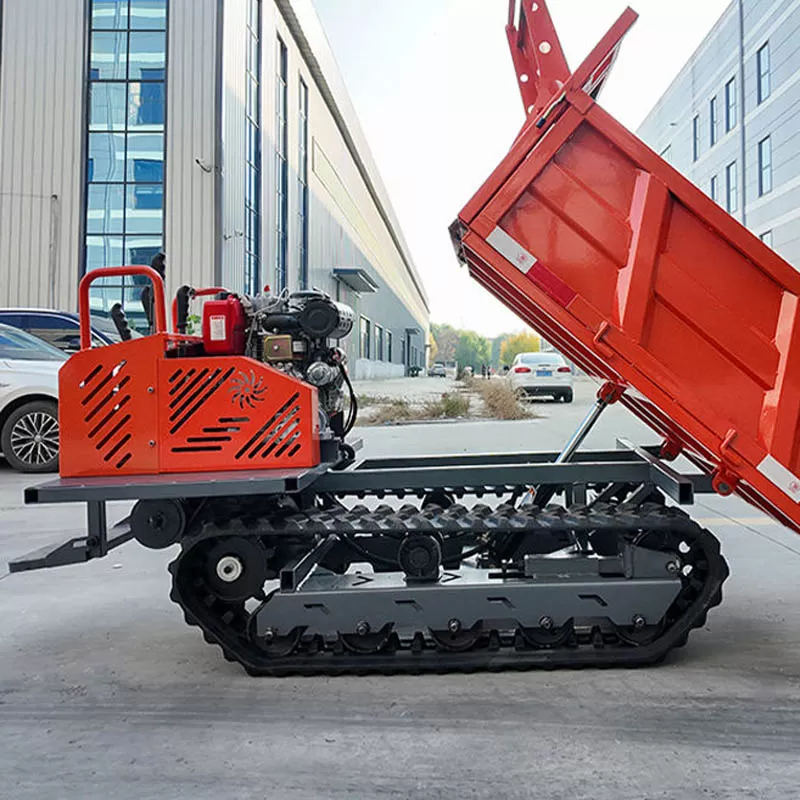
The brake system of a mini dump truck typically includes core components such as the brake pedal/lever, brake master cylinder, brake fluid, brake slave cylinder (caliper), brake pads/brake shoes, brake disc/brake drum, and connecting pipelines. These parts work together through hydraulic or mechanical cables (depending on the model) to convert the driver's braking commands into friction on the wheels, thereby achieving vehicle deceleration or stopping. Mini dump trucks mostly use pneumatic braking systems, with some lightweight models using hydraulic drive. The core structure is as follows:
Brake type: The mainstream is drum brakes (brake drum + brake shoes), with some front axles equipped with disc brakes;
Driving method: Primarily pneumatic drive, supplied by an air compressor, and pushing the brake shoes through the air reservoir, brake valve, and brake chamber.
Brake fluid, as the medium for transmitting braking force, directly affects the responsiveness of the braking system. In addition, the friction performance and wear of the brake pads and brake discs also determine the effectiveness of each braking action.
2.1 Brake Pedal/Lever Feel
Before starting work each day, press the brake pedal or pull the handbrake, paying attention to its free travel and feedback force. Excessive softness, excessive travel, or an increased "spongy" feeling often indicates problems such as water absorption in the brake fluid, air entering the system, or internal leakage in the master cylinder, requiring further inspection.
2.2 Brake Fluid Level and Quality
Check the brake fluid level in the brake master cylinder reservoir to ensure it is within the recommended range. Brake fluid has the characteristic of absorbing moisture, which over time can lead to a decrease in the fluid's boiling point and reduced braking performance. Brake fluid should be replaced regularly according to the manufacturer's instructions, usually a thorough inspection and replacement is recommended annually or at specified mileage intervals (depending on the specific vehicle model).
2.3 Brake Pad and Brake Disc Wear
Visually inspect the brake pads (or brake shoes) and brake disc surfaces for obvious wear, cracks, or excessive scorching. Insufficient brake pad thickness or severely scratched brake disc surfaces will significantly reduce braking effectiveness and may cause vibration or noise.
3.1 Regular Brake Fluid Replacement
Brake fluid deteriorates during use due to heat cycles and moisture absorption from the environment. Once the moisture content becomes too high, it will reduce braking performance and may lead to brake failure. Therefore, it is recommended to perform vacuum fluid replacement or flushing according to usage conditions and manufacturer-specified intervals to ensure fluid cleanliness and improve the stability of the braking system.
3.2 Adjustment and Repair of Brake Components
As usage time increases, the gap between the brake pads and brake discs/drums will change, requiring regular adjustment and calibration. For some mini dump trucks equipped with mechanical adjustment devices, the adjustment bolts and cables should also be checked and adjusted to ensure consistent braking response.
Lubricating the brake caliper sliding guides, piston components, and hinge points can reduce sticking and prevent brake malfunction or uneven braking on one side.
3.3 Inspection of Brake Lines and Connectors
Brake fluid flows through the lines, and the lines and connectors are frequently subjected to vibration and temperature changes. Regularly check the rubber hoses for cracks, swelling, or leaks, and the metal lines for corrosion and looseness to ensure there are no hydraulic leaks.
|
Maintenance Project |
Recommended cycle |
Inspection Standards |
Change threshold |
|
Brake pad thickness |
Check every 30,000 kilometers |
Visual inspection + caliper measurement |
≤3mm (must be replaced) |
|
Brake fluid |
Every 2 years or 20,000–40,000 kilometers |
The liquid level is between MAX and MIN, and the color is clear. |
Moisture content >3% or oil that is black and cloudy |
|
Brake lines and connectors |
Each maintenance |
No cracks, no leaks, no expansion |
Replace immediately if it is aging or deformed. |
|
Automatic adjusting arm |
Every 60,000 kilometers |
It rotates smoothly without jamming. |
Abnormal noise or gaps require replacement. |
|
Brake drum/ disc |
Every 80,000–100,000 kilometers |
The surface is free of deep grooves (>0.5mm) and cracks. |
Replacement is required if the parts exceed the limit or are deformed. |
4.1 Brake Pad Replacement Procedure
Safety Preparation: Engage the parking brake, place wheel chocks in front of and behind the tires, and use a hydraulic jack and support stands to lift the wheel;
Disassembly and Inspection: Remove the wheel hub cover, remove the brake pads, and check the inner wall of the brake drum for smoothness, grooves, or cracks;
Clean Guide Pins: Use sandpaper to remove rust from the caliper guide pins, and apply high-temperature lubricant (temperature resistance ≥260℃);
Install New Pads: Ensure the anti-noise shims are intact, the backing plates are free of oil stains, and install them in their original positions;
Reset Caliper: Use a special tool to compress the piston, avoiding excessive pressure from fluid backflow.
4.2 Brake System Bleeding (Important!)
✅ Requires two people and assistance from a vacuum pump
Operating Instructions:
1. Remove the brake fluid reservoir cap and add DOT4 standard brake fluid (Shell Ultra and Mobil 1 recommended)
2. Start from the furthest wheel: Right rear → Left rear → Right front → Left front
3. Loosen the bleeder screw on the brake caliper, one person slowly presses the pedal to 1/3 of its travel, and the other person uses a vacuum pump to draw out the air.
4. Repeat 8-10 times until the fluid is clear and free of bubbles.
5. Tighten the screw, add fluid to the MAX line, and tighten the reservoir cap.
⚠️ Do not use inferior brake fluid or mix DOT3/DOT4 fluids, otherwise the boiling point will drop sharply, leading to brake fade on downhill slopes.
4.3 Gap Adjustment (Only for vehicles without automatic adjustment arms)
Use a 14mm wrench to loosen the adjustment arm locking nut;
Rotate the adjustment arm clockwise to set the gap between the brake shoe and the brake drum to 0.5–0.8mm;
Both sides must be symmetrical, with an error of ≤0.1mm;
After tightening the nut, lightly press the brake pedal several times to feel if the pedal rebound is even;
Do not adjust when hot; if the brake drum temperature is >60℃, it must be cooled to room temperature.
|
Fault phenomenon |
Possible reasons |
Solution |
|
Brake noise (sharp metallic sound ) |
Brake pads worn to their limit; warning disc in contact with drum/disc; foreign object embedded; caliper return spring broken. |
Replace brake pads; remove foreign objects; replace return spring. |
|
Brake pull |
One-sided brake caliper stuck; uneven clearance between left and right sides; out-of-round brake drum. |
Check the piston movement of the brake caliper; readjust the clearance; replace the brake drum. |
|
The brake pedal is soft and has a long travel. |
Brake fluid leak; air in the system; excessive water content in the brake fluid. |
Bleed the brake fluid; check for leaks (wheel cylinders, brake lines); replace brake fluid. |
|
Brake drum overheats and turns blue |
Prolonged heavy-load downhill driving; malfunctioning brake return mechanism. |
Avoid continuous braking and switch to engine braking; check if the adjusting arm is stuck. |
Following the maintenance procedures described above will ensure that the mini dump truck's braking system remains in good working order, improving operational safety and reducing the risk of accidents caused by brake failure. As a maintenance engineer, performing preventative maintenance not only saves long-term costs but also improves the equipment's operational efficiency and reliability.

